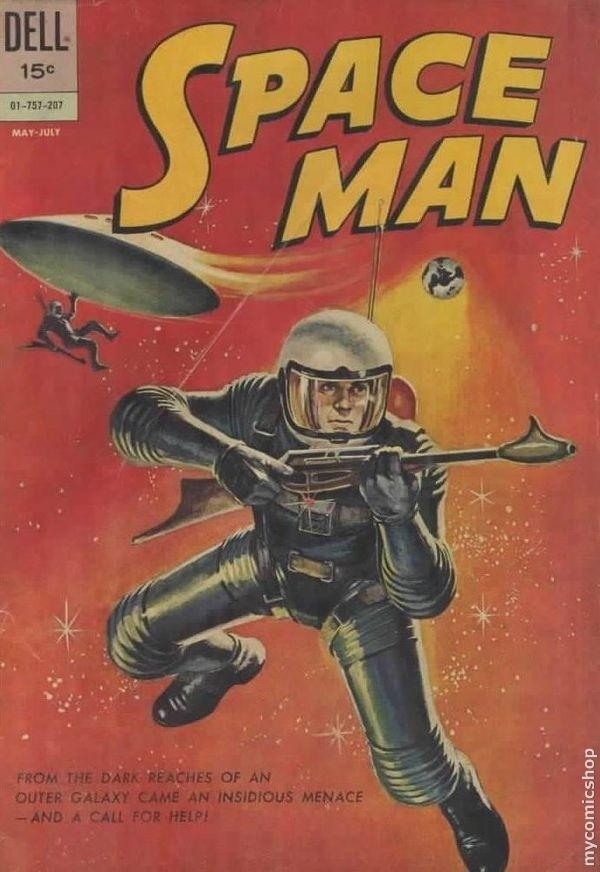
GEROMINO! Building a vast, interplanetary empire will take some military muscle, as foreseen in this early comic book
By C. Michael Forsyth
CAPE CANAVERAL, Fla. — Good news! NASA scientists have uncovered evidence that there are scores of inhabitable planets within rocket-ship distance — and Earthmen may soon be able to build a vast galactic empire!
“Astronomers have cracked the Milky Way like a piñata, and planets are pouring out so fast they don’t know what to do with them all,” the prestigious New York Times announced triumphantly.
“Scientists operating NASA’s planet-hunting Kepler satellite reported that they had identified 1,235 possible planets orbiting other stars, tripling the number of known planets.”
Best of all, many of these “exoplanets” are believed to be what are dubbed Type M planets in Star Trek lingo — planets capable of sustaining human life!
“Fifty four of the exoplanets are in so-called habitable zones of stars, where temperatures should be moderate enough for liquid water,” the Times reports.
The discovery by Kepler, which was launched in 2009, opens the door to colonization of other planets, most likely led by the only superpower in the world with the necessary money and technical know-how — the United States.
“It boggles the mind,” Kepler’s team leader William Bourick of the Ames Research Center in Northern California told the paper excitedly.
NEW WORLDS TO CONQUER! Our galaxy is packed with planets, as shown in this NASA artist's conception.
Plans are already being drawn up by NASA for colonies on the closest of the planets. Though some planets may require domed colonies because they lack the proper atmosphere, others may have all the oxygen we need, in addition to drinkable water, fertile land and valuable natural resources.
“For the first time in human history we have a pool of rocky, habitable planets.” declared top MIT expert Sara Seager.
The sheer number of planets — all ripe for the picking — has astounded scientists, who once doubted there were any other Earth-like planets in the galaxy, or perhaps only a small handful.
“This is sending me back to the drawing board,” flabbergasted Kepler astronomer Jack Lissauer told the science mag Nature.
One top Yale astronomer strongly agreed, telling a Times reporter that the game-changing discovery “blows the lid off everything we thought we knew about expolanets”
Experts say this will go down as one of the key turning points in human history, right up there with our ape-like ancestors’ descent from the trees.
Geoffrey W. Marcy of the University of California, Berkeley declared that what he called the “extraordinary planet windfall” is a “moment that will be written in textbooks.”
If the stunning New York Times report is accurate — and given the paper’s solid reputation there’s no reason to believe it’s not — it means that contact with intelligent life on nearby worlds is almost inevitable.
A few scientists — including famed astrophysicist Stephen Hawking — have expressed concern that our alien neighbors may soon invade Earth and have warned that we cease and desist beaming “Hi, here we are“ radio messages into space.
But the vast majority of experts contend that its far more likely that WE will be the conquerors and in a relatively short time will have dozens of colonies — perhaps as new U.S. states — under our belt.
That’s because most life forms on other planets are likely to be pre-industrial, agrarian folks who’ve barely developed muskets — if they’ve even invented the bow and arrow. They’ll be no match for an armada of American-made spaceships armed to the teeth with smart bombs, laser-guided missiles and tactical nukes, Defense Department planners by and large agree.
There’s a small possibility that the U.S. may instead establish peaceful relationship with the locals, with a strict no-interfering-with-the-natives rule like the inviolable (and routinely broken) “Prime Directive” in Star Trek. However, given America’s track record, that’s highly doubtful.
“Within the next 40 years or so you’ll be reading about indigenous E.T.s being rounded up and removed to special ‘protective’ areas on their planets,” predicted a Harvard historian. “If you don’t believe me, go ask a Mohican.”
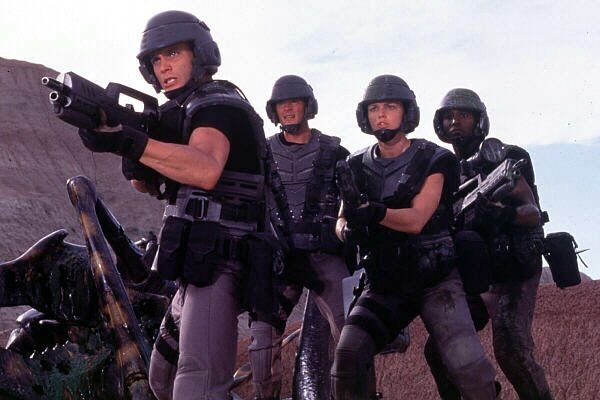
E.T. and his buddies won’t have a prayer when confronted by the superior firepower of America’s brave soldier-astronauts, depicted here in the movie “Starship Troopers.”
Copyright C. Michael Forsyth
TERRIFYING, SEXY: C. Michael Forsyth's horror novel Hour of the Beast.
To hear Chapter One of Hour of the Beast FREE click HERE.
Long before Boris Karloff appeared in "The Mummy," Sir. Arthur Conan Doyle wrote of a tragic, immortal Egyptian obsessed with an ancient love.
By C. Michael Forsyth
Every reader knows of Sir Arthur Conan Doyle as the creator of Sherlock Holmes. Fewer are aware that he also invented Professor Challenger, whose visit to a plateau frozen in prehistory in The Lost World was a forerunner to Jurassic Park.
But hardly anyone knows that Doyle also wrote many horror stories and was a brilliant master of the genre. A collection of these can be found in TheHorror of the Heights & Other Strange Tales. And what a delightful treat these tales are!
I suppose one shouldn’t be surprised that the father of literature’s most enduring character would bring considerable creativity to bear. But it’s remarkable how Doyle invented many of the staples of supernatural fiction.
His story “The Great Keinplatz Experiment,” anticipates the many body-swapping movies Hollywood has churned out, like “Freaky Friday,” “18 Again,” “Prelude to a Kiss,” and Rob Schneider’s hilarious “The Hot Chick.”
AHEAD OF HIS TIME: Sir Arthur Conan Doyle could frighten readers as well as baffle them with mysteries,
His “Lot. 249” introduces the shambling, homicidal mummy that would decades later send chills up the spines of movie goers in The Mummy. Another story, “The Ring of Thoth,” precedes “The Mummy” ’s theme of an immortal Egyptian driven by love spanning the centuries.
The story “The Horror of the Heights,” is about an airplane menaced by a monster that dwells in the clouds. It would be echoed in the classic 1963 “Twilight Zone” episode in which William Shatner, recovering from a nervous breakdown, is the only passenger aboard a plane to see a mysterious creature tampering with the engine.
As a writer, I’m often frustrated at how often I’ll come up with what I believe to be an original idea for a supernatural story, only to discover that “The Twilight Zone” got there first. Well, again and again, Conan Doyle beats Rod Serling to the punch.
"STEWARDESS!" William Shatner discovers a new reason to take the bus in the classic Twilight Zone episode "Terror at 20,000 feet."
The most truly fascinating thing about these stories is that each includes a clearly outlined mechanism for the supernatural occurrence, lending the tales unusual realism.
Remember, Conan Doyle was an ardent believer in the occult. He vouched for mediums and ascribed to their pseudoscientific cosmology (ectoplasm, astral planes and the like). He believed in telepathy, psychometry, clairvoyance — and even fairies, championing those dubious “fairy photographs” as legitimate.
In most modern horror novels and movies, the supernatural element requires total suspension of disbelief. We are simply supposed to accept that there are vampires, werewolves, ghosts, zombies or whatever, with the why and how left unanswered.
In occult-expert Conan Doyle’s stories there is always a logical explanation for the supernatural events, no matter how fantastic. For example, in the body-switching story, the spooky fun starts when a professor and his assistant, sitting side by side, simultaneously attempt out-of-body projection.
And in “Horror of the Heights,” the denizens of the upper atmosphere are life forms that one might reasonably believe could inhabit the sky — unlike the lumbering, Abominable Snowman-like “gremlin” of “The Twilight Zone” episode.
IT'S A WRAP! The 1932 movie "The Mummy" has a precursor in one of Conan Doyle's stories.
Beyond that, the twisty, sometimes grimly humorous stories deliver the requisite scares. There were none that I didn’t like. My favorite was “The Parasite,” in which a hypnotist’s parlor exhibition at a cocktail party leads to harrowing consequences for the subject. This tale features a storyline you definitely WON’T recognize from Hollywood movies. And it builds up to a nail-biting climax even Sherlock Holmes wouldn’t foresee.
Horror reaches new heights in collection of scary tales by the creator of Sherlock Holmes.
Copyright C. Michael Forsyth
If you only read ONE werewolf novel this week, make it Hour of the Beast by C. Michael Forsyth.
Nazi monster Adolf Hitler butchered millions in World War II.
By C. Michael Forsyth
A Minneapolis couple is appealing a judge’s decision that bars them from naming their newborn baby Adolf Hitler.
Judge Anthony J. Karwaski imposed the injunction on October 2, ruling that it would be “cruel and irresponsible” to burden a child with the name of the Nazi madman, because the youngster is likely to be mercilessly teased.
Since the story came to light, the parents have been bombarded with hate mail, branding them as antisemites, Nazi scum and skinheads. But the tot’s father, a tax attorney, insists that the government shouldn’t stick its nose into private family business and that strangers should “mind their own beeswax.”
“This stuff about antisemitism is just plain crazy,” declares Noah Hitler, 38. “We’re Jewish ourselves, for Heaven’s sake. When your last name is Hitler, you’re going to take some ribbing. We figure you might as well go whole hog and be Adolf, so you can at least have some fun with it.
“Sure, we could name our son ‘Felix,’ like my mother-in-law wants us to do. But does anyone really think a kid named Felix Hitler won’t get teased in school?”
Noah’s family hails from the Corinthian province of Austria, where Hitler is a fairly common name. His grandfather Kurt, who barely escaped from Auschwitz with his life, refused to change his last name when he emigrated to America, because they’d been a prominent family in the town for many generations.
“When I got my law degree and was sending out resumes, I thought about changing my name,” admits Noah. “But Grandpa sat me down and said, ‘Hitler is a proud name — no matter how much a certain idiot tried to ruin it.’ ”
The family believes that the teasing risk is being blown out of proportion.
Silent film legend Charlie Chaplin, seen here in “The Great Dictator,” is often confused with Adolf Hitler by high schoolers, educators say.
“Little kids don’t know who Hitler is, and most American teens today don’t either,” points out mom Rachel Hitler, 29, a high-school English teacher.
“I recently showed five of my seniors a picture of Hitler and asked them who it was. One had no idea, three identified him as Charlie Chaplin and another said Buster Keaton!”
A higher court is not expected to rule in the case until June. Until then, the baby is officially listed as Child 268 in documents. The father is confident that in the end, parental rights will trump other concerns and the boy will grow up Adolf Hitler.
“Yeah, he’ll probably get some good-natured kidding from buddies at the workplace. He’ll definitely have to develop a thick skin,” says Noah. “But the name will be a great conversation starter at house parties.
“And I wouldn’t be surprised if it helps him pick up girls when he’s a young man. Imagine introducing yourself to a couple of cuties at a bar. They say, ‘Naw, I don’t believe it.’ You show them your driver’s license and they’re totally blown away and call over all their pretty friends.”
Copyright C. Michael Forsyth
If you enjoyed this mind-bending story by C. Michael Forsyth, check out his collection of bizarre news, available on Kindle and in other eBook formats.
.
If you only read ONE werewolf novel this month, make it Hour of the Beast by C. Michael Forsyth.
Check out the terrifying Hour of the Beast by clicking HERE.
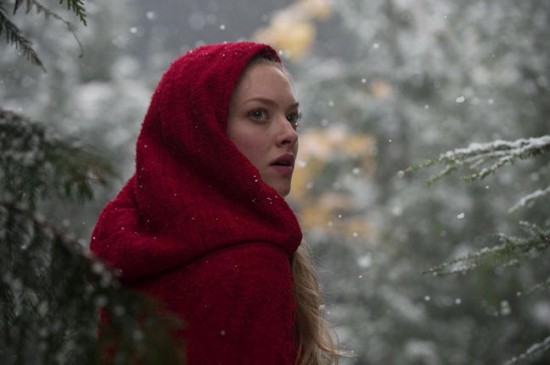
Amanda Seyfried as Red Riding Hood takes an ill-advised stroll in the woods.
By C. Michael Forsyth
Red Riding Hood is exactly what it should be: a grownup retelling of one of our most memorable fairytales, with a horror spin. It has interpersonal conflict, a complex storyline, romance — but it also stays true to the elements that made the tale so compelling to us as children. There is the underlying theme of sexual awakening, the symbolism of the red cape, the opposition of good and evil. Even the talking wolf, the walk through the woods to grandmother’s house and the line, “What big eyes you have,” are worked in.
The high production values — sumptuous period costumes and sets — completely immerse us in a medieval world, and yet the swooping, swerving camera lends the film modern-day immediacy — as well as a perpetual feeling of unease.
In its creation of an olden-days town surrounded by menace, the atmospheric film is reminiscent of M. Night Shyamalan’s “The Village.” But here, the story is NOT torpedoed by awful plot turns.
Red Riding Hood is Valerie (Amanda Seyfried), a pretty young woman in love with a poor woodcutter. Her parents disapprove of him and the lovebirds are about to run off together when the body of her sister is discovered, killed by a werewolf. The village men vow to track down the beast and they quickly do — they think.
Then arrives Reverend Solomon, a werewolf-hunter extraordinaire who is a mixture of Cotton Mather and Robert E. Howard’s witch-hunting Puritan man of action, Solomon Kane. Rev. Solomon (Gary Oldman) warns the townsfolk that the creature they’ve just killed is an ordinary wolf, and that the real werewolf does not dwell in a mountain cave, as they believe — but is instead one of them. A paranoiac “Who Goes There?” type nightmare ensues, as Valerie struggles to figure out which of those around her is the murderous monster — while avoiding a horrible fate as its prime target.
Is the Big Bad Wolf her dark, brooding, black-clad boyfriend? The strangely feral village idiot? The handsome young blacksmith who seems so gentle and fearful? Or even her own extremely creepy grandmother (played with magnificently, and gleefully, by Julie Christie)?
To make matters worse, the town’s “savior” Rev. Solomon emerges as an Ahab-like lunatic who doesn’t care who he has to imprison, torture, put to the sword or use as human bait to take down the lycanthrope.
The mystery angle in this kind of story is always hard to pull off. After all, the screenwriter has to come up with a solution today’s savvy movie audience wouldn’t easily guess and yet at the same time, makes perfect sense. The very satisfying ending of this film fulfills both goals.
I appreciate the filmmaker’s choice to eschew blood and guts for genuine suspense and chills. I’m not one of those horror geeks who gets off on seeing people’s bodies being destroyed in steadily more sickening and bloody ways. (Apologies if that’s you — don’t mean to alienate half my readers.) However, I think director Catherine Hardwicke went a bit too far in keeping gore out of the picture. When the first couple of corpses are discovered, they are so bloodless and undamaged that it looks like footage from a dress rehearsal. I mean, they’re supposed to have been killed by a wolf — pardon me, a giant, rampaging werewolf — and it was hard to believe they were even in a bar fight!
My other minor quibble is that the villagers initially ignore Rev. Solomon’s warning that the werewolf is one of them — and instead hold a big victory party celebrating the slaying of the wolf . This provides the movie-makers with a great opportunity to show a chaotic and unnerving medieval festival, complete with weird masks and Bacchanalian dancing. But come on. First of all, shouldn’t it be OBVIOUS that the human who turns into a wolf lives in the isolated village? And don’t these ignorant peasants respect the opinion of this famed champion werewolf-hunter? In most period movies — and, I believe, actual history too — medieval folk have a low threshold for turning on their neighbors and accusing them of supernatural evil.
After writing this review, I checked Rotten Tomatoes and I was surprised that critics gave it a ranking of only 11 percent. Well, I’m sticking to my guns. You’ll have fun watching this movie, as did most audience members, who gave it a ranking six times higher.
Curiously enough, a few hours after I saw “Red Riding Hood,” I watched on DVD “The Brothers Grimm,” which also incorporateselements of fairytales. Not as effective a film, with its anything-can-happen approach to the supernatural. But it certainly made for an interesting double bill. Kind of like last weekend when I saw “Con Air” and “The Expendables” back to back — and my testosterone level shot through the roof!
Copyright C. Michael Forsyth
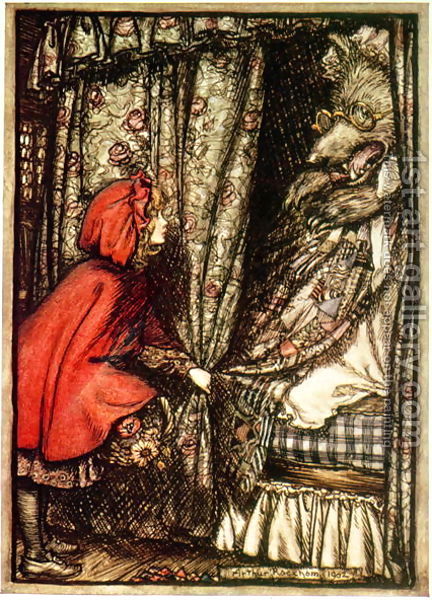
"Who, me a wolf?" In classic fairytale, Little Red Riding Hood is a bit slow to realize her "grandmother" is not what she seems.
Like to be scared? Read C. Michael Forsyth's Hour of the Beast.
By C. Michael Forsyth
To hear Chapter One of the acclaimed Hour of the Beast FREE click HERE.
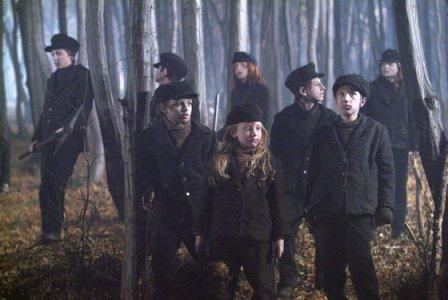
"Hey, what are you kids doing out here in the woods?" is a question best not asked of these undead urchins.
By C. Michael Forsyth
“Wicked Little Things,” now out on DVD, is a scary movie with a wickedly clever premise.
In 1913, the heartless owner of the Carlton Mine in Addytown, Pa. uses poor children for exploration, until the exploited kids are buried alive in an explosion. Now, nearly a century later, the restless undead tykes roam the woods, taking their bloody vengeance upon the living.
The main character is recently widowed Karen Tunny (Lori Heuring), who moves with her daughters Sarah and Emma into her late husband’s boyhood home near the mine. It isn’t long before 16-year-old Sarah (Scout Taylor-Compton) returns home with tales of pick axe-wielding zombie children who kill anyone foolish enough to venture into the woods at night. And 9-year-old Emma begins to hang out with a mysterious “imaginary friend” who just wants to play.
The movie has enough thrills to justify a respectable three pick axes up rating. In one highly memorable sequence, in which little Emma is led by children’s laughter to the mouth of the abandoned mine, the suspense is almost unbearable.
Excellent performances. Chloe Moretz, who more recently dazzled us as a vampire nymphet in “Let Me in,” is compelling as sweet, angelic Emma. A pleasant surprise is the great English actor Ben Cross of “Chariots of Fire” fame as creepy neighbor Aaron Hanks — the most convincing portrayal of a hillbilly by a British Islander since Liam Neeson’s impressive turn as Patrick Swayze’s shotgun-toting cousin in “Next of Kin” (1989).
The movie has two big problems, however, and they’re related. Horror films work best when the filmmakers create characters we care about and then put them in jeopardy.
We care about innocent, vulnerable Emma, which is why the scene mentioned above works so well. However, it soon turns out that both Hanks and the Tunny family are relatives of the zombie children, who recognize the blood of their kin and leave them unharmed. The zombie kids really DO just want to play with Emma and she’s actually off screen for the most critical scenes of the movie!
It is also revealed that the curse will be lifted when the ghostly children kill the last remaining descendent of the mine owner. That happens to be William Carlton (Martin McDowell), an arrogant, greedy, ruthless tycoon who is kicking people off their land to build a ski resort near the mine. The trouble is that you WANT this selfish, cowardly weasel to be killed. If he were sympathetic, the film’s climax — with the pick axe pixies closing in on him, Hanks and the Tunnys — would be truly terrifying.
Check out a movie with this cursed-bloodline theme that worked really well: “The Four Skulls of Jonathan Drake.” In that 1959 oldie-but-goodie, the hero’s ancestor led a massacre of South American villagers. Vengeful supernatural headhunters have claimed the noggins of the male heirs in each generation ever since. And our hero is next in line for the head-shrinking treatment!
My other beef with the film is that the undead tots don’t only kill people, they eat them! Given their origins, one would expect these revenants to be more of the wraith-like variety, rather than flesh and blood monsters that require sustenance. (Especially since, presumably, the youngsters’ physical bodies were trapped under tons of rock.)
Just because they’re zombies do they HAVE to eat human flesh? Someday, I’d like a filmmaker to REALLY reinvent the zombie genre. (Sorry, “28 Days Later” fans, but making ’em run fast instead of shuffle isn’t reinventing). I mean create a new mythology, the way George Romero did with “Night of the Living Dead” in 1968.
Hey, if no one else steps up to the plate, I might just have to do it myself, by jiminy, as my old Weekly World News colleague Ed Anger would say.
C. Michael Forsyth is the author of "Sir Arthur Conan Doyle & Harry Houdini in The Adventure of the Spook House,""The Blood of Titans," "Hour of the Beast" and "The Identity Thief." He is a Yale graduate and former senior writer for The Weekly World News


 E.T. and his buddies won’t have a prayer when confronted by the superior firepower of America’s brave soldier-astronauts, depicted here in the movie “Starship Troopers.”


 .
.


 Horror News