The graphic novel Severed was written by Scott Snyder and Scott Tuff, illustrated by Attila Futaki.
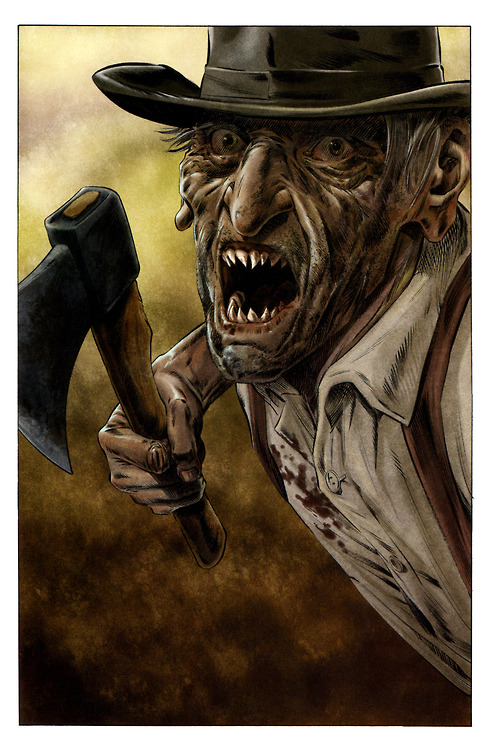
Severed is a viscerally scary graphic novel. Set in 1916, it is the tale of 12-year-old Jack Garron, who runs away from the home of his adopted mother with one dream: to find his father, a wandering guitar player. Instead he finds a nightmare: A serial killer with razor-sharp teeth who preys on children.
It’s hard to make comic books genuinely frightening. They lack the immediacy and realism of movies. They also can’t get into your head the way prose novels can, turning your own imagination into a fear factory.
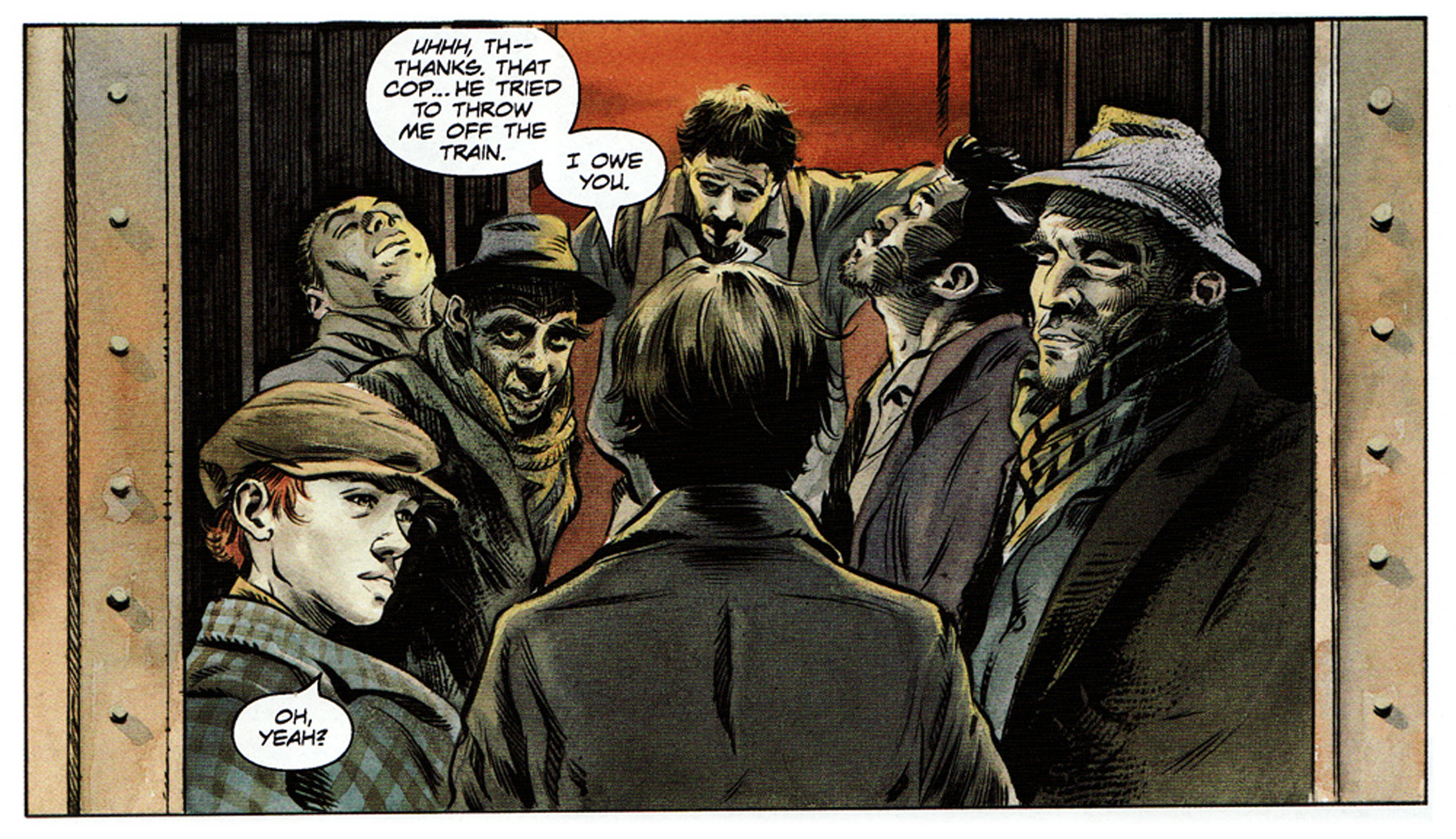
What makes Severed so chilling is its realism; its unnerving depiction of a harsh early 20th century America where poor children were rarely truly safe. In that way, it’s reminiscent of the eerie movie classic, Night of the Hunter. No child protective services. No “safety net.” No food stamps. No Amber alerts. Even before Jack faces the monstrous maniac, he is exposed to dangers such as railroad hobos who try to molest him. A roving predator who feeds on the dreams – and flesh – of the innocent is made entirely believable. The grisly saga unfolds with inexorable logic.
A cannibal madman with teeth filed to points roams America preying on the innocent.
While 30 Days of Night employed an expressionistic style to convey a sense of the supernatural, the artwork here is naturalistic, in keeping with the text. The layout
is highly cinematic, the framing so akin to movie camera angles that the pages look a lot like storyboards. In fact Severed would make a terrific film, though an extraordinarily dark and nasty one.
In the “good old days” there was no shortage of predators of all types.
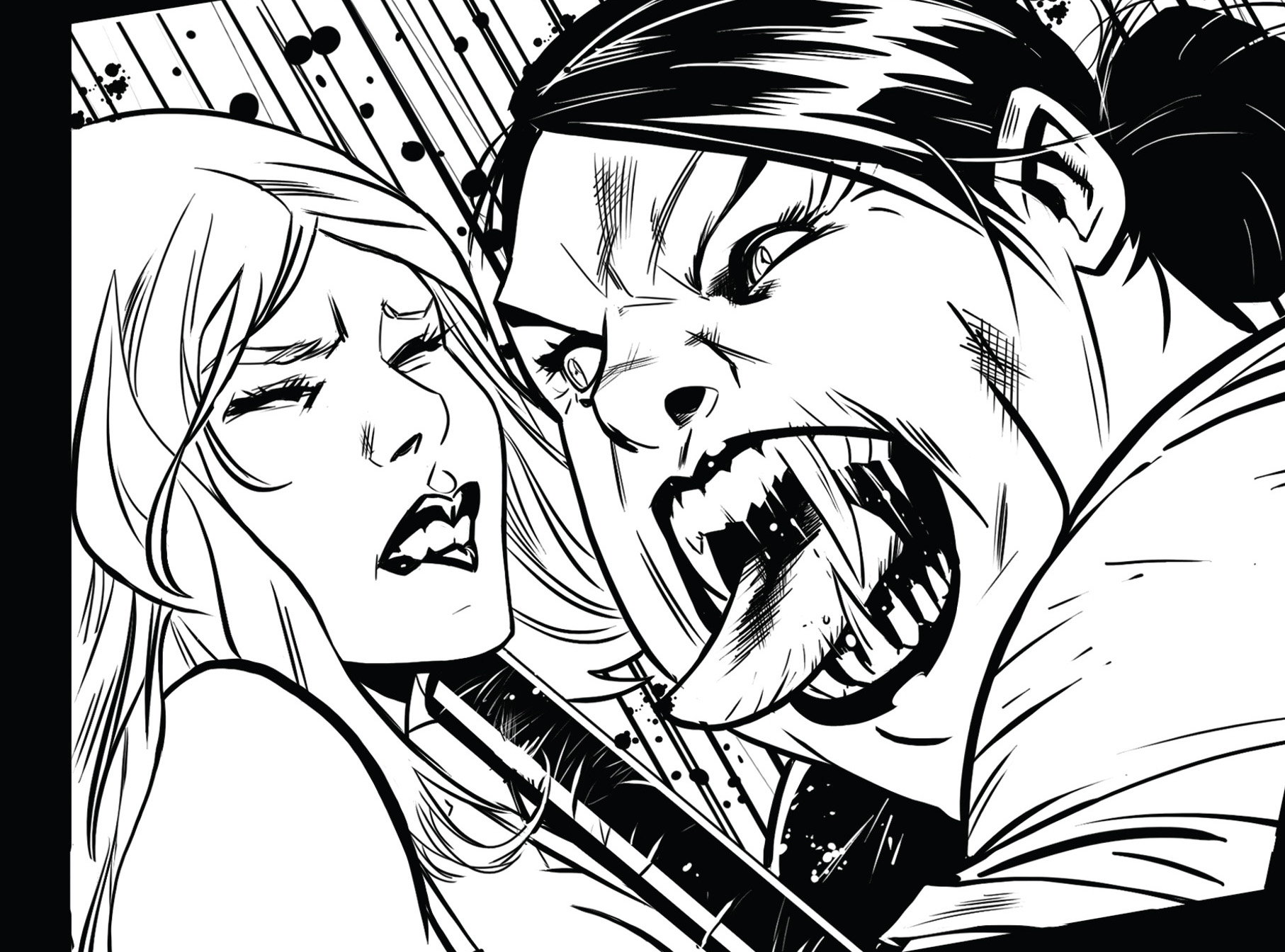
Vampires run amok in a women’s prison in the gorgeously illustrated, 80-page graphic novel Night Cage. When a newly made vampire is sentenced to an escape-proof, underground slammer, she quickly begins to spread the contagion.
The tables turn on an identity thief in the latest thriller by C. Michael Forsyth.
This review was written by the author of the new thriller The Identity Thief.
ZOMBIE farm labor is expected to outpace migrant labor by 2019.
By C. Michael Forsyth
SAN MATEO, Calif. — Most ordinary folks see the widening zombie epidemic with fear — but corporate America sees big profits! Agribusiness giants are gradually replacing migrant workers with zombie farm workers who can pick fruit, lettuce and other crops at a fraction of the cost.
“There are many jobs that living Americans won’t do, and undocumented aliens will do but only if compensated financially,” explained an industry insider. “Zombies don’t demand pay, don’t require rest breaks, don’t need healthcare or other benefits and don’t burden an employer when injured on the job. If they lose a hand on a piece of farm equipment they just keep going.”
Legislation now wending its way through Congress will help smooth the transition from illegal alien to zombie labor. If signed into law, House of Representatives Bill 8263, The American Protection of Personhood Act, would define a person as “a human being not capable of sustaining life when shot through the heart or other vital organs apart from the brain.”
“The language excludes zombies from labor laws,” the insider explained. “That means that zombie laborers are exempt from the minimum wage, workplace safety rules, limitations on hours, the Family Leave Act and other cumbersome Federal regulations.”
Not having to worry about government red tape will help the farm industry compete with foreign food producers, analysts say.
“This is just the kind of boost the U.S. economy could use right now,” says economist Gerard N. Lunkster.
OLD SCHOOL: Zombies have worked the fields of Haiti since the early 1800s.
The first known use of zombie labor in the western hemisphere was in Haiti in the early 1800s when they were commonly seen harvesting sugarcane. The Haitian government imposed a ban on their use in the 1960s.
“Contrary to what you may have seen in the cinema and on TV, real zombies are quite docile when fed and cared for properly,” said an expert. “They are well suited to farm work. Attempts to train them to do jobs requiring more manual dexterity, such as assembly line work, have by and large been unsuccessful.”
Labor leaders are fighting the bill tooth and nail, warning that employing zombies will displace living workers. But farm industry lobbyists dismiss those concerns.
“Don’t worry about jobless people — zombies need to eat don’t they?” joked the insider. “Just kidding. But seriously, if some unemployed vagrant does trespass on a farm trying to steal food or looking for a handout, and winds up a meal, that’s not the farmer’s concern. You can’t prosecute zombies for homicide because they’re not legally people.”
UNLIKE the vicious creatures in TV shows like “The Walking Dead,” most real zombies are docile, compliant and unlikely to strike.
Copyright C. Michael Forsyth
The tables turn on an identity thief in the latest thriller by C. Michael Forsyth.
If you found this story by fiction writer C. Michael Forsyth entertaining, you might enjoy his thriller The Identity Thief.
Legendary horror maestro Dario Argento tries to recapture the feel of classic Hammer Studios flicks.
By C. Michael Forsyth
When I saw a poster for Dario Argento’s Dracula 3-D, which had the look of an old Hammer Studio’s movie, I was skeptical. There have been so many versions of the original novel, including Francis Ford Coppola’s big-budget Bram Stoker’s Dracula, was there any point in trying another lavish costume epic? Hasn’t the story been drained dry? But Italian director Argento is a legend in the horror genre, the creator of such masterpieces as the atmospheric and suspenseful Susperia. How bad could it be?
Pretty darned bad, it turns out. I should have taken that “3-D” in the title as a warning.
This stinker received a well-deserved 11 % rating on Rotten Tomatoes. One reviewer put it so succinctly I’ll just quote him: “Argento’s Dracula 3-D is an absolute travesty of a film completely devoid of creativity or imagination. It’s like taking your favorite folklore, stripping it of everything you love, making it as dull as possible, and then lighting it on fire,” wrote Chris Swann of Examiner.com
Thomas Kretschmann plays a rather unenergetic Dracula.
The best that can be said is that Argento does not simply retell the tale we all know so well. He revamps it with the main elements intact, but details changed in unexpected ways. The problem is that in almost every case, the changes are for the worse. Jonathan Harker does not escape from the castle; instead he’s killed almost immediately — robbing the movie of its logical hero. Instead of Dracula crossing the ocean and menacing Mina in England, all the action takes place in Transylvania. Instead of three brides, Dracula only has one. But three was better, right? Dracula turns into unexpected animals in addition to the usual bat and wolf. Unfortunately, the critters are absurd, especially a giant praying mantis rendered in unconvincing CGI!
AMPLY endowed vampire Tania bares more than fangs.
Among the movie’s other glaring flaws: The budget did not seem to allow for set decoration. In scene after scene, whether it be a tavern or a room of a mansion, there is literally nothing on the walls.
German actor Thomas Kretschmann is a lackluster Dracula, injecting the same amount of passion into the role as if he were standing in line at Starbucks waiting to order a latte. Initially, his staid and dignified manner works, when he plays the “old” Dracula Jonathan Harker first meets in the castle. The trouble is that low-energy approach continues throughout the entire film.
The actress playing Lucy is so homely you wonder how she got the part. Oh wait, she’s Asia Argento, the director’s daughter. Which makes the gratuitous nude scene where she’s bathed by Mina a little creepy.
There are a few good things about the movie. Rutger Hauer plays Dr. Van Helsing, though he appears late in the film, has little to do and is not nearly as good as you’d hope he’d be. And Miriam Gionvanelli does an admirable job as the buxom beauty Tania who becomes Dracula’s sole bride, petulant and jealous with the impressive cleavage that brings back fond memories of the great Hammer films. Making one of Dracula’s brides a speaking role was one of the few interesting choices.
THE DOCTOR is in. Rutger Hauer as Van Helsing.
I did like the twist that the villagers are actually Dracula’s protectors. In exchange for their not heading up the hill to the castle with pitchforks and torches he’s made them wealthy – and even built a school for the kids. The scene in which the town fathers plot against the aristocratic vampire and Drac takes bloody vengeance is just about the only good one in the movie. But sadly, overall I can only give the movie a one out five stake rating.
IN A RELATED STORY…
PRISON life becomes even more hellish when a vampire epidemic erupts in a women’s prison.
I’m excited to announce the launch of my first graphic novel, Night Cage! The premise of the horror story is simple: Vampires take over a women’s prison. Just imagine Orange is the New Black meets Salem’s Lot.
The project is being funded through Kickstarter. Folks who jump on the bandwagon will get a boatload of goodies and rewards, ranging from advance copies of the book and exclusive art, posters and T-shirts to a chance to be drawn into the graphic novel as a character!
Please check out the video out HERE, and share the news with all your social media friends!
PRISONERS fight for survival against a bloodthirsty army of the undead in the graphic novel Night Cage.
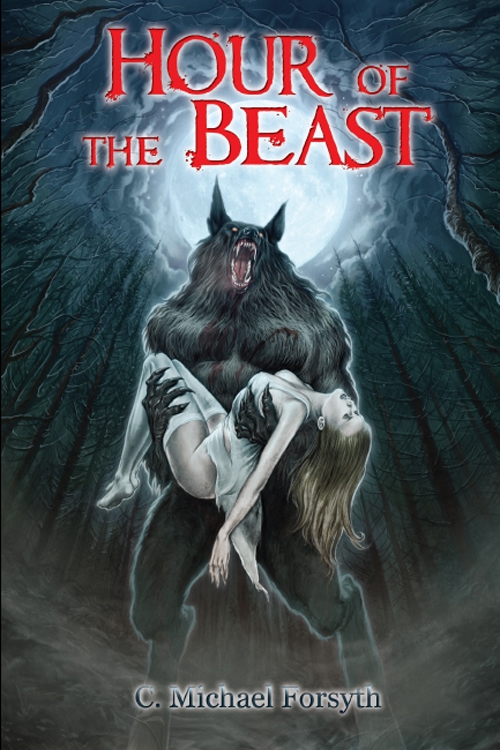
Speaking of horror, if you want a good scare check out my horror novelHour of the Beast.
In Hour of the Beast, a young bride is raped by a werewolf on her wedding night. When her sons grow up and head to college, things REALLY get out of hand.
C. Michael Forsyth is the author of "Sir Arthur Conan Doyle & Harry Houdini in The Adventure of the Spook House,""The Blood of Titans," "Hour of the Beast" and "The Identity Thief." He is a Yale graduate and former senior writer for The Weekly World News








 Horror News