Werewolf hunters for hire pursue their most dangerous quarry ever — a man-beast who attacks even when the moon isn’t full.
By C. Michael Forsyth
My friend Sean, a horror aficionado with an encyclopedic knowledge of the genre, recommended “Werewolf: the Beast Among Us,” and he didn’t steer me wrong. I really enjoyed this fun, twisty B movie.
Shot in Romania with excellent production values, it’s in some ways a throwback to the old Hammer films. No automatic weapons, no sweet and glittery monsters. Some might call this anachronistic, but I dug the old-fashioned good-versus-evil battle.
The movie, set in the 1800s, features a band of werewolf hunters for hire that comes to the rescue of a town plagued by a lycanthrope. Alarmingly, the creature strikes even when the moon isn’t full! They’re aided by a young man desperate to save his village from the unstoppable beast, which has slain dozens. It’s “The Magnificent Seven” with werewolves – a high concept I just love.
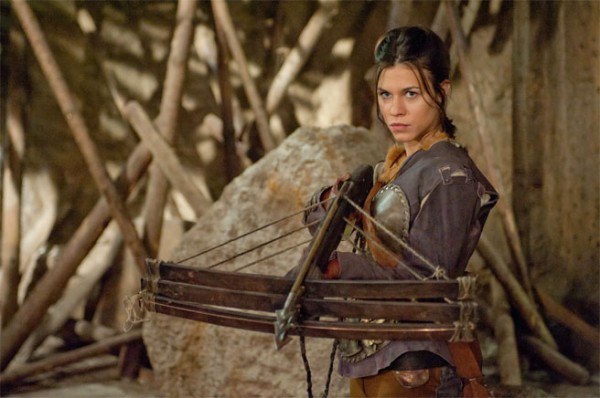
The team is led by Charles (Ed Quinn), a taciturn American gunslinger, and each of the mercenaries has different quirks and specialties. My favorite is the sexy girl bounty hunter Kazia who wields a crossbow and wears a bite-proof corset. There’s also the suave, unflappable Englishman Stephan, who sports a vest full of throwing knives. Steven Bauer (Al Pacino’s right-hand man in “Scarface” and almost unrecognizable here) is aboard as the grizzled, beer-swilling Hyde.
Action and gore abound and there’s a mystery too. Which villager is the beast? Could it be the youth himself? His mother, who always appears to be missing when the attacks occur? His girlfriend? Her reclusive, wealthy father?
Day to day life in a town besieged by a werewolf is depicted with entertaining realism. In one memorable scene, the beleaguered town doctor (Stephen Rea from “The Crying Game”) is deluged by victims – and mercifully puts down a bitten farmer to spare him from the curse.
TAKE NO PRISONERS: Werewolf stomper Kazia (Ana Ularu) is deadly with a crossbow.
SPOILER ALERT – SPOILER ALERT – SPOILER ALERT
The identity of the werewolf isn’t too hard to figure out – the culprit practically has “lycanthrope” stamped on his forehead. But there are some clever red herrings, including the suspicious town constable who turns out merely to have epilepsy. (It might have been prudent for him to warn fellow villagers, “I foam at the mouth from time to time, so please don’t shoot me.”)
Although it’s the most surprising twist, I didn’t really like the revelation that Stephan is a vampire – I preferred him as a cocky dandy. I mean, when Charles recruited a vampire didn’t it occur to him that the guy might TURN OUT TO BE EVIL???
Likewise, the ending in which Charles takes on the werewolf as Stephan’s replacement seems a bit dubious. Having a monster on board didn’t really work out all that well. And wouldn’t the new recruit be a little reticent about killing other werewolves? ——————————————–
THRILLING NEW GRAPHIC NOVEL
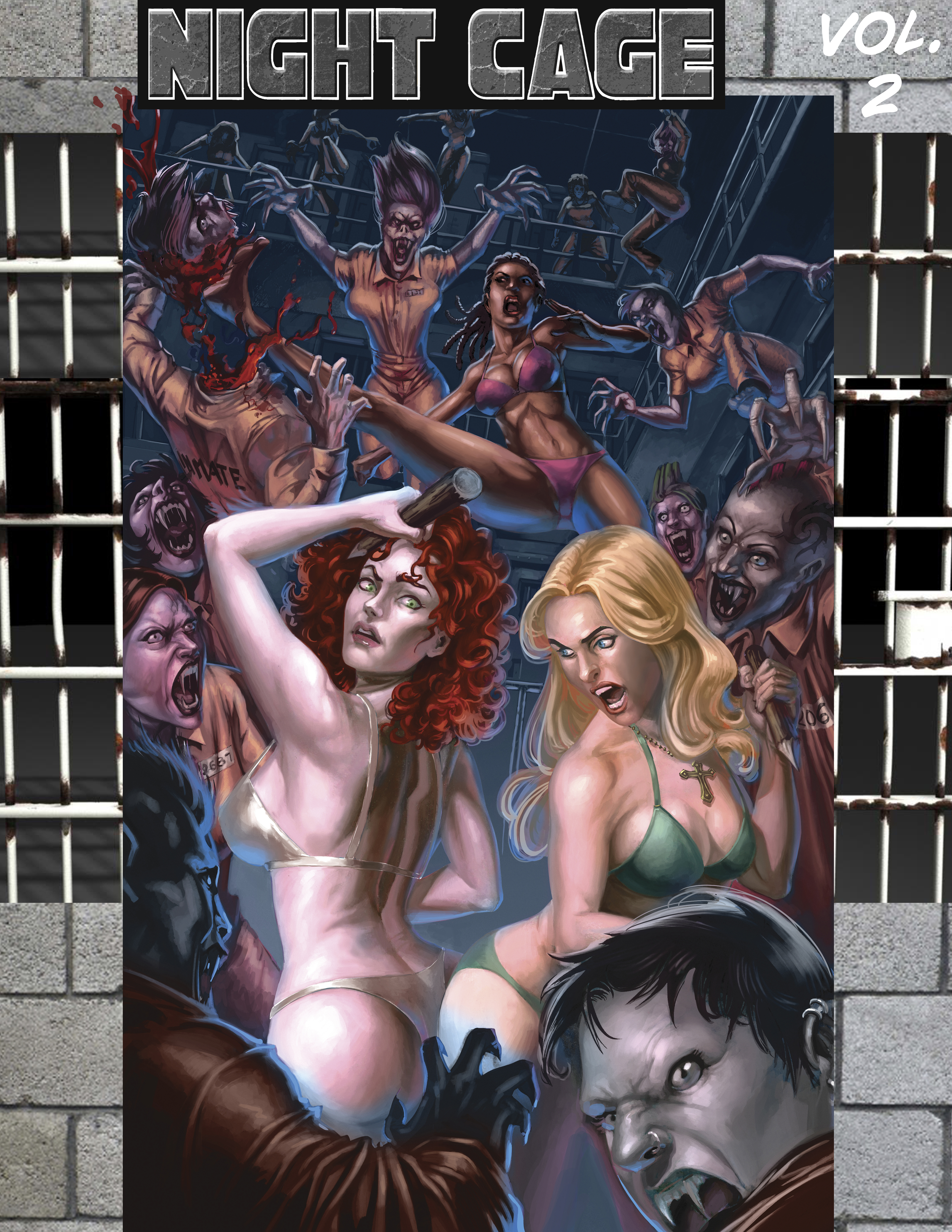
If you enjoyed this article by C. Michael Forsyth, check out his latest work. Vampires take over a women’s prison in the graphic novel Night Cage. Imagine ‘Salem’s Lot meets Orange is the New Black.
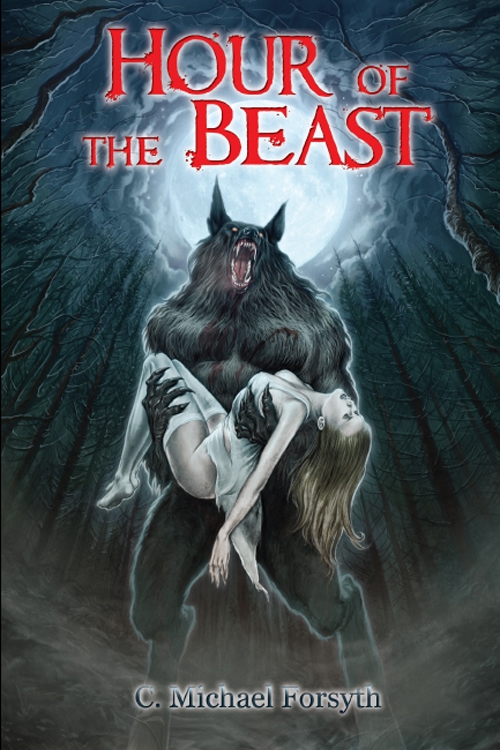
Speaking of our hairy pals, the author of this review also penned the highly acclaimed horror novel “Hour of the Beast.” Hour of the Beast is available in hardcover and softcover at Amazon.com. But you can save $4 by clicking HERE! The Kindle version is just $7 and the Ebook is a measly $5. Be the first on your block to read this bone-chilling tale — before the movie comes out.
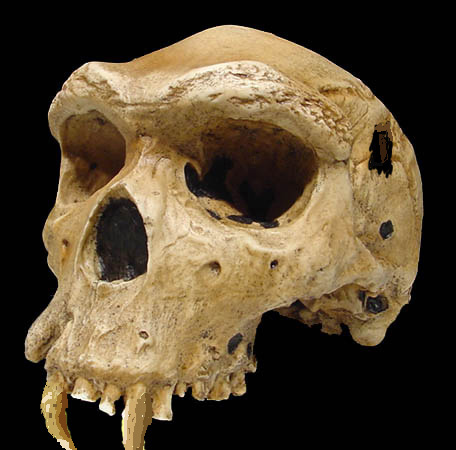
NEWLY discovered Homo Lycanthropus bore elongated cuspids, or canine teeth.
By C. Michael Forsyth
MONTIGNAC, France — Paleoanthropologists have reported the discovery of the 27,000-year-old skeleton of a previously unknown prehistoric hominid that may have given rise to the werewolf legend.
Experts are calling the startling find in the Vezere Valley the most remarkable development in the field of paleoanthropology since the Hobbit, known scientifically as Homo floresiensis, was found on a remote Indonesian island in 2003.
Dubbed Homo lycanthropus, the early man stood over seven feet tall, boasted a prognathous jaw with razor-sharp canine teeth, a massive brow ridge, and ears positioned high, giving it an oddly canine appearance.
Scientists believe that the caveman coexisted peacefully with Cro-Magnon Man, the precursor to modern humans, because the remarkably intact skeleton was found in a burial mound side by side with bones belonging to our ancestors.
“The evidence suggests that not only did Homo lycanthropus or the Wolf Man live alongside our forebears, he played a vital role in Paleolithic society,” says Dr. Antoine de Begereaux, leader of the university team that made the find.
“This demonstrates that a great deal remains to be learned about human evolution.”
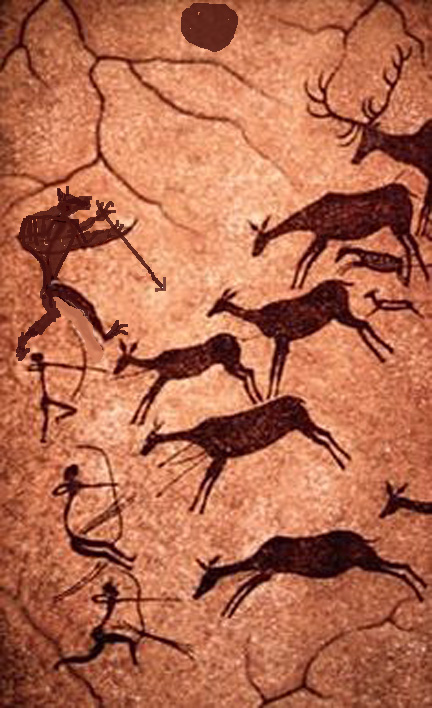
PREHISTORIC cave painting featuring enigmatic “beast-man” has baffled scientists for decades.
The discovery may shed new light on the famous prehistoric paintings found in the Lascaux cave complex just 25 kilometers away in 1940.
One particularly striking set, uncovered by spelunkers in 1974, is known to scientists as the Famine and Hunt Cycle. The series of paintings depict what anthropologists refer to as the first known use of sequential art.
In the first of six painting, a group of men and women huddle about a campfire, portrayed as extremely thin and presumably hungry. In the second painting, one of figures has risen and is striding into the woods, with a circle that appears to be the full moon overhead. In the third painting, the figure now has a huge head with pointy ears and runs on all fours. In the fourth, the mysterious figure is seen returning to the fire, walking erect and carrying a stag in each hand.
In the fifth panel the beast-man leads a band of bow-wielding hunters, now apparently well fed enough to walk, into the woods. In the sixth and final panel, the hunting party encircles a herd of deer.
“Previously, it was theorized that the beast-man figure was wearing a ceremonial mask as some kind of animal-god ritual,” says Dr. de Bergereaux. “Now, a more likely theory is that Homo lycanthropus went hunting for game when other members of the tribe were too weak and famished, and brought back meat to save the group.
“Far from being perceived as a monster or a threat, these gentle giants were probably seen as protectors of the tribe.”
Scientists say that the large, hairy cavemen probably hunted during the full moon because it was easier to see.
“At that time of the month as they ventured into the wild, they may have become more fierce, robust and hirsute, just as domestic pigs quickly sprout bristly hair and develop seven-inch tusks when they become feral,” notes French science writer Jean Paul Rhiens, who calls the discovery “intriguing.”
DNA tests will be conducted to see exactly where the Wolf Man belongs on the human evolutionary tree; whether it is a subspecies of Homo sapiens or a cousin to mankind.
“We know that about 2 percent of modern-day Europeans carry some Neanderthal DNA,” notes Dr. de Bergereaux. “It’s certainly not out of the realm of possibility that a small fraction of humans alive today have genes from Homo lycanthropus.”
Copyright C. Michael Forsyth
The preceding story is a work of fiction that we hope you found entertaining and thought-provoking. If you enjoyed this story by C. Michael Forsyth, check out his upcoming project:
————————————————————————————————————-
A THRILLING NEW GRAPHIC NOVEL:
Vampires take over a women’s prison in this scary and sexy graphic novel that has been described as ‘Salem’s Lot meets Orange is the New Black. A Kickstarter is underway right now!
If you enjoyed this mind-bending story by C. Michael Forsyth, check out his collection of bizarre news, available on Kindle and in other eBook formats.
.
Speaking of werewolves, The Horror Fiction Review gives this writer’s novel Hour of the Beast “two thumbs up and a lusty howl at the moon. This Christmas, give the gift of scary fun. The eBook is a measley $5!
You can purchase Hour of the Beast at Amazon.com or save $4 by clicking HERE
C. Michael Forsyth is the author of "Sir Arthur Conan Doyle & Harry Houdini in The Adventure of the Spook House,""The Blood of Titans," "Hour of the Beast" and "The Identity Thief." He is a Yale graduate and former senior writer for The Weekly World News



 .
.

 Horror News